
Equipment identification guide
HVAC model, serial, and AHRI numbers: what each proves
Learn the difference between HVAC model numbers, serial numbers, and AHRI references, where to find them, and how to use them to verify a quote.
Direct answer
Direct answer
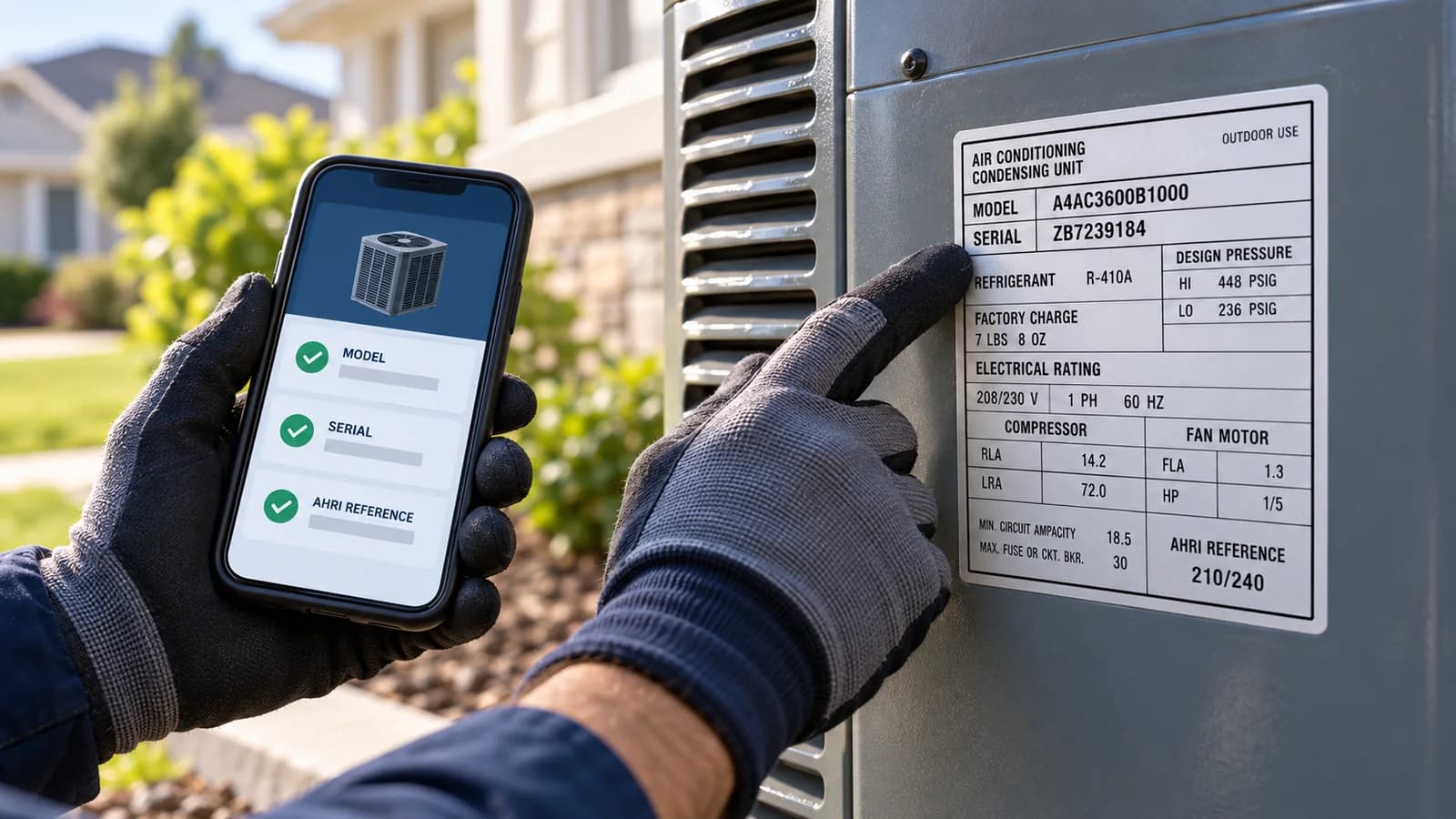
An HVAC model number identifies an equipment design and often encodes details such as product family, nominal capacity, electrical characteristics, or revision. A serial number identifies one physical unit and may help establish manufacture or warranty records. An AHRI reference identifies a certified combination of indoor and outdoor components with published performance ratings. These numbers are related but not interchangeable. For a replacement quote, collect every exact model number and the AHRI certificate before signing. After installation, add each serial number and keep photos of the data plates, registration confirmations, and startup records.
Key takeaways
- Model number identifies the equipment design; serial number identifies the individual unit; AHRI reference identifies a certified matched system.
- A model-family name or outdoor-unit rating does not prove the performance of the complete installed combination.
- Photograph labels only when safely visible from outside the cabinet, and protect serial numbers and personal records when sharing documents.
The three identifiers answer different questions
Treat the three numbers as separate evidence fields. The model number answers 'what equipment design is this?' The serial number answers 'which individual unit is this?' The AHRI reference answers 'which tested component combination and certified ratings apply?' A contractor proposal usually needs model numbers and an AHRI reference before installation. Serial numbers normally become available when the physical equipment is delivered or installed.
| Identifier | What it identifies | When to collect | What it does not prove |
|---|---|---|---|
| Model number | Equipment design, family, size code, and revision where encoded | Before signing and after installation | The identity of the individual unit |
| Serial number | One physical unit | At delivery or installation | The complete matched-system rating |
| AHRI reference | Certified indoor and outdoor component combination | Before signing and after any equipment change | Installation quality or home fit |
| Family or marketing name | Broad product position | Early comparison only | Exact models, ratings, or installed scope |
Sources: [ahri-directory], [ahri-overview], [daikin-nomenclature], [trane-model-table]
Copy the full model number exactly
One character can distinguish capacity, region, refrigerant generation, feature set, electrical specification, or revision. Do not shorten the model to a family nickname and do not drop letters, leading zeros, suffixes, asterisks explained by the document, or revision characters. Ask the contractor to place the full outdoor unit, indoor coil or air handler, furnace when relevant, control, and accessory models on the proposal. After installation, compare those entries with the visible data plates and final invoice.
Sources: [daikin-nomenclature], [trane-model-table]
Decode only what the manufacturer documents
Some manufacturers publish nomenclature tables that explain model positions. Daikin's DC9VS technical document, for example, maps positions to brand, equipment type, efficiency class, compressor type, feature set, region, nominal capacity, electrical characteristics, and revision. That does not make the same character positions valid for Trane, Carrier, Lennox, or another Daikin family. Use the exact technical document for the exact family and date. If the manufacturer does not define a field, label it unknown rather than guessing.
Sources: [daikin-nomenclature]
Use the serial number for the individual unit record
Serial numbers distinguish physical units that share one model number. They are important for registration, warranty lookup, service history, recalls or bulletins where applicable, and proving which equipment was installed. Serial formats and date codes vary by manufacturer and can change over time, so use the manufacturer's current lookup or support process. Do not estimate age from an internet decoder when a manufacturer or authorized record can confirm it.
Sources: [trane-warranty], [daikin-warranty]
Use the AHRI reference to verify the matched system
Central HVAC ratings often depend on the outdoor unit, indoor coil or air handler, and sometimes the furnace or other tested configuration. Search the AHRI directory using the reference supplied by the contractor or the exact component models. Confirm that the certificate lists every proposed component and the certified capacity and efficiency values being represented. Save a copy. If the installer substitutes a component, require a new match check before accepting the change.
Sources: [ahri-directory], [ahri-overview]
Do not confuse nominal capacity with delivered capacity
A code such as 24, 36, 48, or 60 often corresponds to a nominal BTU-per-hour class in manufacturer nomenclature, but that pattern is not universal and it does not establish the exact delivered capacity of a matched system. Use the manufacturer table to interpret the model, then use the AHRI certificate and design conditions for certified performance. Finally, use a home-specific load calculation to decide whether the selected capacity fits the building.
Sources: [daikin-nomenclature], [trane-model-table], [ahri-directory], [energy-star-qi]
Photograph labels without opening equipment
Only photograph a data plate when it is safely visible on the exterior or in documentation already provided to you. Do not remove a service panel, reach around energized equipment, enter an unsafe attic, or disturb refrigerant or electrical components to find a label. Ask the installer to supply clear photos of inaccessible indoor labels. Before sharing an invoice or label publicly, remove your name, address, phone, email, financing data, signatures, account numbers, QR codes, and serial numbers unless the recipient genuinely needs them.
Run a proposal-to-installation identity check
Create one row for each promised component. Before signing, enter its full model number and the AHRI reference. At delivery, compare carton or data-plate models before equipment is permanently connected when practical. At handoff, add serial numbers, installation date, permit or inspection record where applicable, registration confirmation, and startup data. Mark any substitution and require written approval, updated ratings, price, warranty, and scope before accepting it.
Sources: [ahri-directory], [energy-star-qi]
Keep one durable system record
Store the signed proposal, final invoice, all model and serial numbers, data-plate photos, AHRI certificate, permit and inspection records, warranty certificates and registration confirmations, maintenance requirements, control information, and commissioning readings together. Keep a homeowner copy separate from anything shared publicly. This record makes future warranty, service, sale, and repair-or-replace decisions faster and reduces the chance that a nearby model's specification is applied to your system.
Sources: [trane-warranty], [daikin-warranty], [energy-star-qi]
Decision checkpoint
| What you know | What to ask next |
|---|---|
| The quote lists a product family | What are the complete outdoor, indoor, control, and accessory model numbers? |
| The contractor states a SEER2 or capacity | Which AHRI reference proves those values for the exact proposed combination? |
| The equipment has been installed | Do the installed models match the proposal, and are all serials, registrations, and startup records retained? |
Common questions
Frequently asked questions
Is a model number the same as a serial number?
No. A model number identifies an equipment design shared by many units. A serial number identifies one physical unit.
Is an AHRI number printed on the outdoor unit?
The AHRI reference is typically provided on a certificate or match record rather than serving as the outdoor unit's model number. Ask the contractor for the certificate and verify it in the directory.
Can I determine tonnage from the model number?
Sometimes a manufacturer-documented capacity code helps, but patterns are not universal. Confirm the exact nomenclature and the AHRI-rated capacity instead of relying on a generic decoder.
Why does the indoor model matter?
The indoor coil or air handler affects the certified combination and can change capacity and efficiency. The outdoor unit alone does not define the full central system rating.
What if the installer substitutes a model?
Pause acceptance and request the reason, updated AHRI certificate, specifications, warranty, scope, and price in writing. Do not assume a close-looking model is equivalent.
Is it safe to post my HVAC serial number online?
Treat serial numbers as private equipment identifiers. Share them only when needed for warranty or service, and redact personal, account, financing, signature, QR-code, and address information from public documents.
Continue your decision
Sources
- AHRI Directory of Certified Product PerformanceUse the AHRI reference or all exact component model numbers to verify the certified matched system.
- AHRI: Directory of Certified Product PerformanceExplains that consumers can search certified HVAC products by product line, rating, or brand.
- Daikin: DC9VS R-32 Technical Specifications and NomenclatureOfficial example showing that model-number positions and meanings are manufacturer and family specific.
- Trane: 16 Single-Stage Air Conditioner Model TableOfficial example of full outdoor model numbers, nominal sizes, dimensions, refrigerant, and model-specific EnergyGuide links.
- Trane: Warranty and RegistrationOfficial registration and warranty starting point. The exact certificate and jurisdiction control.
- Daikin: Warranty InformationOfficial warranty starting point illustrating why individual equipment identity and registration records matter.
- ENERGY STAR: HVAC Quality InstallationSizing, duct, airflow, refrigerant-charge, and installation-quality framework.