
Current Trane model-family guide
Trane 20 vs. 18 TruComfort: compare the complete system
Compare Trane 20 and 18 TruComfort variable-speed air conditioners by exact model, matched performance, controls, footprint, scope, and value.
Direct answer
Direct answer
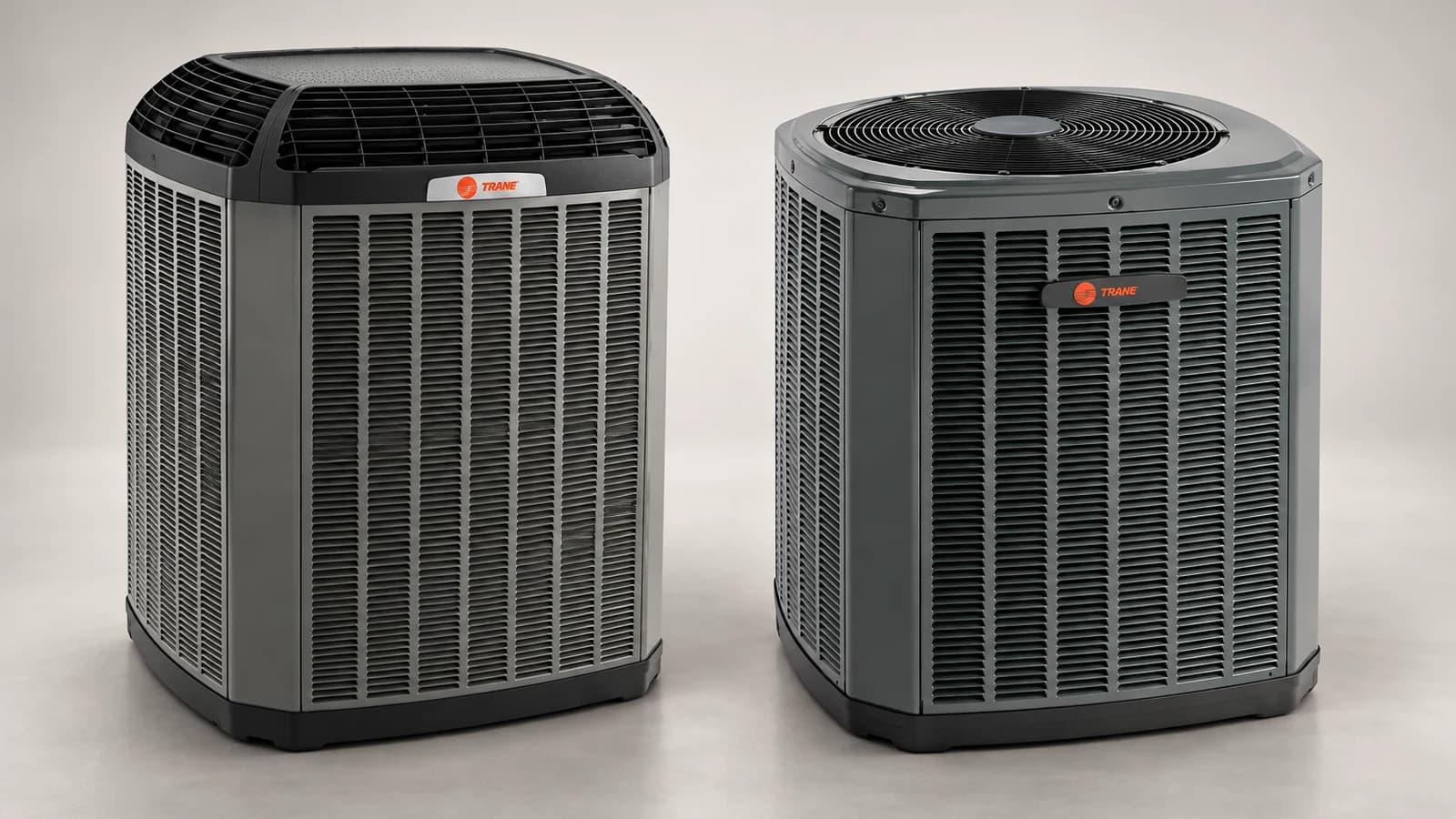
The Trane 20 and 18 TruComfort air conditioners are both variable-speed systems, but they are not identical. Trane's current product material lists up to 700 compressor stages for the 20 family and up to 75 for the 18, with both able to vary capacity from about 30% to 100%. The published sound-power headline is as low as 57 dB(A) for the 20 and 58 dB(A) for the 18. Those are useful differences to ask about, but they are not a promise that every installed 20 will be quieter or cheaper to run. Compare the exact model, matched indoor equipment, control, AHRI certificate, load and duct evidence, cabinet fit, installation scope, warranty, and total price. The better proposal is the one whose complete system fits the home and documents what the premium actually buys.
Key takeaways
- Both families are variable-speed, but the 20 lists up to 700 compressor stages versus up to 75 for the 18.
- Manufacturer sound-power headlines are close: as low as 57 dB(A) for the 20 and 58 dB(A) for the 18. Exact model and placement still matter.
- Get the exact capacity, indoor match, control, AHRI certificate, commissioning record, warranty, and complete installed price in writing.
First confirm which equipment is actually being quoted
Product names are not enough. Trane's current 20 TruComfort page lists outdoor models beginning with 5TTV0, while the 18 TruComfort page lists 5TTV8. Record the full outdoor model, indoor coil or air handler, furnace if used, thermostat or system control, accessories, and AHRI reference. A proposal that says only 'Trane 20 variable speed' or 'Trane 18 variable speed' is incomplete because tonnage, indoor pairing, and configuration remain unknown.
| Decision row | 20 TruComfort | 18 TruComfort | What proves it |
|---|---|---|---|
| Official outdoor prefix | 5TTV0 | 5TTV8 | Full model on proposal and data plate |
| Capacity control | Variable-speed, up to 700 compressor stages; about 30–100% capacity range | Variable-speed, up to 75 compressor stages; about 30–100% capacity range | Current manufacturer brochure and exact model documentation |
| Published sound power | As low as 57 dB(A) | As low as 58 dB(A) | Manufacturer sound data for the exact model and capacity |
| Listed refrigerant | R-454B | R-454B | Exact model documentation |
| Listed nominal sizes | 2 through 5 tons, with two listed 2-ton cabinet options | 2 through 5 tons | Current official model table |
| Certified performance | Varies by indoor and outdoor match | Varies by indoor and outdoor match | AHRI certificate |
Sources: [trane-20], [trane-18], [ahri-directory]
Do not compare family maximums as if they were your ratings
A family name and a brochure maximum are orientation, not the rating of every combination. The AHRI certificate should identify the exact outdoor unit, indoor coil or air handler, furnace where part of the tested match, cooling capacity, and applicable efficiency ratings. Ask the contractor to provide the certificate before signature and confirm that every model on the certificate matches the written proposal. If a component changes, the certificate should be rechecked.
Sources: [ahri-directory], [ahri-overview]
What the extra compressor stages actually mean
The 20 has more published speed steps than the 18, so it can make smaller adjustments as the load changes. That can help reduce temperature swings, improve long low-output run time, and support humidity control when the complete system is set up correctly. It does not mean the 20 runs at 700 different homeowner-selectable settings, and it cannot overcome bad sizing, restrictive ducts, poor airflow, or a mismatched control. Ask the contractor to explain the expected low-stage behavior, indoor airflow, humidity setup, and what the control will actually command in this home.
Sources: [trane-20], [trane-18], [trane-air-conditioner-brochure], [trane-controls]
Compare sound in a way you can use
Trane's published headline sound-power figures are close: as low as 57 dB(A) for the 20 and 58 dB(A) for the 18. That is not a one-decibel guarantee at every capacity, and sound power is not the same thing as what you will hear at a bedroom window or patio. Ask for the exact model's sound data, identify whether the number is sound power or sound pressure, and review the planned placement, pad, wall proximity, fencing, and nighttime operating expectations. A quieter-rated unit in a poor location can still be annoying.
Sources: [trane-20], [trane-18], [trane-air-conditioner-brochure]
Check cabinet dimensions against the actual site
The official current tables show different cabinet dimensions by model. The 18 family models are listed at 41 inches high, with width and depth changing by size. The 20 family table lists models from 46 to 51 inches high and also varies in width and depth. These figures are not clearance requirements. Ask the installer to document the selected unit's dimensions, manufacturer clearances, service access, drainage, pad or stand, line and electrical routing, and any property or access constraint at the proposed location.
Sources: [trane-20], [trane-18]
Make the R-454B scope explicit
The current official pages list R-454B for both families. The quote should still state the refrigerant, indoor compatibility, required safety provisions, line-set plan, evacuation and commissioning process, technician training, and future service path. Refrigerant cannot be handled safely by a homeowner. Do not open equipment, loosen fittings, or treat a refrigerant-family label as proof that an existing indoor unit or line set can be reused.
Sources: [trane-20], [trane-18], [trane-r454b]
Use a home-fit test before paying for the higher tier
Ask what measured problem the 20 proposal solves better than the 18 proposal in this home. Useful evidence can include a load calculation, selected capacity at design conditions, duct and static-pressure findings, comfort complaints, planned zoning, outdoor placement, and documented operating differences. 'Top of the line' is not a home-fit explanation. If both proposals use the same tonnage without showing the load, or if neither addresses a restrictive duct system, the comparison is not ready.
Sources: [energy-star-qi]
Normalize the installation scope before comparing price
Put both proposals into the same rows: indoor and outdoor equipment, control, pad or stand, line set, drain and overflow protection, electrical work, duct changes, filter setup, removal, permits, startup readings, registration, labor coverage, and exclusions. A higher total may include more work, or it may simply carry a product premium. A lower total may be complete, or it may leave necessary work unpriced. The itemized scope is what separates those possibilities.
Sources: [energy-star-qi]
Require a variable-speed commissioning record
Before final payment, ask for the installed model and serial numbers, the matching AHRI certificate, control configuration, airflow and static-pressure readings, refrigerant commissioning data required by the manufacturer, drain and safety checks, operating-mode verification, and homeowner control orientation. Keep these records with the warranty registration. Variable-speed capability on a product page does not prove that the installed system was configured or tested correctly.
Sources: [energy-star-qi], [ahri-directory], [trane-controls]
Apply a simple value decision
Choose the 20 only when the written evidence shows a benefit worth its incremental installed cost for this home. Choose the 18 when it meets the load, comfort, control, fit, warranty, and service requirements without paying for an unneeded difference. Hold both proposals when the match, load, controls, scope, or startup plan is still unclear. This is a proposal comparison, not a claim that one model family is universally more reliable.
Decision checkpoint
| What you know | What to ask next |
|---|---|
| The proposal names 20 or 18 TruComfort | What are every exact model number and the AHRI reference for the complete system? |
| Both are described as variable-speed | Which indoor equipment, control, setup, and commissioning evidence deliver the quoted functions? |
| The 20 carries a higher total | Which documented home-specific benefit and included scope justify the difference? |
Common questions
Frequently asked questions
Is the Trane 20 TruComfort always more efficient than the 18?
Do not decide from family names alone. Compare the certified SEER2, EER2, and capacity on the AHRI certificates for the exact indoor and outdoor combinations.
Are the current Trane 20 and 18 systems both variable-speed?
The official product pages reviewed September 7, 2026 describe both as variable-speed air-conditioner families. Verify the exact quoted models because names and catalogs can change.
Do both current families use R-454B?
The official current model tables reviewed for this page list R-454B. Confirm the refrigerant on the exact proposal, model documentation, and installed data plate.
Will either system work with any thermostat?
Do not assume that. Ask for the exact included control, compatible indoor equipment, and a written list of functions retained or lost with any alternative thermostat.
Which is better for a DFW home?
The better choice is the complete matched proposal that fits the measured load, ducts, site, controls, service plan, and budget. The model family alone cannot answer that.
Should I rely on the outdoor unit's maximum rating?
No. Maximum ratings may apply only to certain matches. Use the AHRI certificate for the exact system being quoted.
Continue your decision
Sources
- Trane: 20 TruComfort Variable Speed Air Conditioner with WeatherGuardOfficial current page and model table reviewed September 7, 2026. It lists 5TTV0 models and R-454B.
- Trane: 18 TruComfort Variable Speed Air ConditionerOfficial current page and model table reviewed September 7, 2026. It lists 5TTV8 models and R-454B.
- Trane: Thermostats and ControlsOfficial control and connected-system overview. Compatibility must be checked by exact system.
- Trane: Air Conditioners product brochureManufacturer brochure used for variable-speed range, compressor-stage, and sound-power comparisons. Exact model and matched-system data control.
- Trane: R-454B Refrigerant GuideOfficial explanation of Trane's lower-GWP refrigerant transition.
- Trane: Warranty and RegistrationOfficial registration and warranty starting point. The exact certificate and jurisdiction control.
- AHRI Directory of Certified Product PerformanceUse the AHRI reference or all exact component model numbers to verify the certified matched system.
- AHRI: Directory of Certified Product PerformanceExplains that consumers can search certified HVAC products by product line, rating, or brand.
- ENERGY STAR: HVAC Quality InstallationSizing, duct, airflow, refrigerant-charge, and installation-quality framework.